
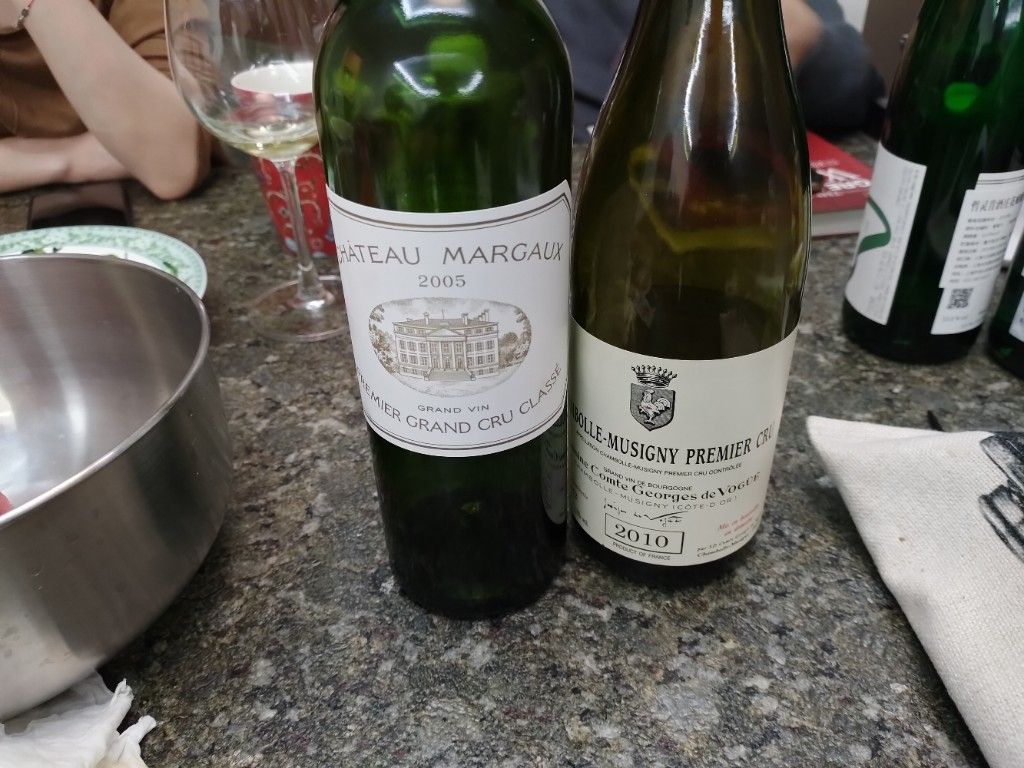
2005 Château Margaux
Red Bordeaux Blend
Auction price: Register or sign-in to see quarterly averages
or visit the Wine Market Journal
Drink by: (Add My Drinking Window)
Advertisement
Who Likes This Wine(35)
-

Philolesen
363 Tasting Notes
-
MC2 Wines
11,092 Tasting Notes
-
mpoel
178 Tasting Notes
Community Tasting Notes (72) Avg Score: points
View all 72 Community Tasting Notes
What Do You Think? Add a Tasting Note
Pro Reviews
Professional reviews have copyrights and you can view them here for your personal use only as private content. To view pro reviews you must either subscribe to a pre-integrated publication or manually enter reviews below. Learn more.

-
By Neal Martin
(Margaux Margaux Red) Login and sign up and see review text.
Margaux Focus 3: Château Margaux (Sep 2023), 9/1/2023, (See more on Vinous...)
Decanter
-
By Charles Curtis MW
(Château Margaux, Margaux, Bordeaux, France, Red) Login and subscribe to see review text.
Bordeaux 2005 retrospective, 6/26/2021, (See more on Decanter...) -
By Andy Howard MW
(Château Margaux, Margaux, Bordeaux, France, Red) Login and subscribe to see review text.
Bordeaux First Growths: 2005 vintage, 6/25/2021, (See more on Decanter...)
JancisRobinson.com
-
By Andy Howard MW
(Ch Margaux Margaux Red) Subscribe to see review text.
6/23/2021, (See more on JancisRobinson.com...)
-
By Antonio Galloni
(Margaux Margaux Red) Login and sign up and see review text.
2005 Bordeaux: Here and Now (Apr 2021), 4/1/2021, (See more on Vinous...)
JancisRobinson.com
-
By Jancis Robinson, MW
(Ch Margaux Margaux Red) Subscribe to see review text.
2/23/2017, (See more on JancisRobinson.com...)
-
By Antonio Galloni
(Margaux Margaux) Login and sign up and see review text.
2005 Bordeaux with Tanzer & Galloni (Nov 2015), 11/1/2015, (See more on Vinous...)
JancisRobinson.com
-
By Jancis Robinson, MW
(Ch Margaux Margaux Red) Subscribe to see review text.
1/29/2015, (See more on JancisRobinson.com...)
Winedoctor
-
By Chris Kissack
(Château Margaux Margaux Red) Login and sign up and see review text.
January 2015, 1/1/2015, (See more on Winedoctor...)
The WINEFRONT
-
By Gary Walsh
(Chateau Margaux) Login and subscribe to see review text.
5/12/2014, (See more on The WINEFRONT...)
Vintage Tastings
-
By John Kapon
(Margaux) Login and sign up and see review text.
'24' in Bordeaux, 1/31/2010
Winedoctor
-
By Chris Kissack
(Chateau Margaux Margaux) Login and sign up and see review text.
November 2009, (See more on Winedoctor...) -
By Chris Kissack
(Château Margaux Margaux Red) Login and sign up and see review text.
November 2009, (See more on Winedoctor...)
Vintage Tastings
-
By John Kapon
(Margaux) Login and sign up and see review text.
Bordeaux Horizontals, 5/11/2009
JancisRobinson.com
-
By Jancis Robinson, MW
(Ch Margaux Margaux Red) Subscribe to see review text.
5/6/2009, (See more on JancisRobinson.com...) -
By Jancis Robinson, MW
(Ch Margaux Margaux Red) Subscribe to see review text.
2/18/2009, (See more on JancisRobinson.com...) -
By Jancis Robinson, MW
(Ch Margaux Margaux Red) Subscribe to see review text.
10/31/2008, (See more on JancisRobinson.com...)
-
By Stephen Tanzer
(Chateau Margaux Margaux) Login and sign up and see review text.
May/June 2007, IWC Issue #132, (See more on Vinous...) -
By Stephen Tanzer
(Chateau Margaux Margaux) Login and sign up and see review text.
May/June 2006, IWC Issue #126, (See more on Vinous...)
JancisRobinson.com
-
By Jancis Robinson, MW
(Ch Margaux Margaux Red) Subscribe to see review text.
4/10/2006, (See more on JancisRobinson.com...)
Decanter
-
By Jane Anson
(Château Margaux, Margaux, Bordeaux, France, Red) Login and subscribe to see review text.
(See more on Decanter...)
NOTE: Some content is property of Vinous and Decanter and JancisRobinson.com and Winedoctor and The WINEFRONT and Vintage Tastings.
Add a Pro Review
Add Your Own Reviews:
Wine Definition
- Vintage2005
- TypeRed
- ProducerChâteau Margaux
- VarietyRed Bordeaux Blend
- Designationn/a
- Vineyardn/a
- CountryFrance
- RegionBordeaux
- SubRegionMédoc
- AppellationMargaux
- Display optionsDefault
- UPC/EAN Code011986100000, 041333214016, 071570017521, 087000346598, 3550871203194, 3760149850054, 400002623786, 607921009039, 607921015368, 649944084181, 714153134733
1/18/2024 - GNBB wrote: 97 Points
Decanted 90 minutes. Deep & intense with little signs of age on rim. Complex, slightly tight nose - deep intense black fruits, black cherries, fresh herbs/thyme, aniseed with a dark chocolate depth. Palate is massive - tons of deep intense rich blackcurrants, plenty of integrated tannins and fresh acidity - well balanced. Lots of aniseed, herbs - a real grip and persistence on the palate. Sensational wine. Decades of life left ahead. Drink 2028-45+.
Do you find this review helpful? Yes - No / Comment
12/26/2023 - Hazeo wrote:
A disappointment, and I hope it’s just this bottle or that it needs more age.
Day 1: Little to no nose upon opening. Very dark fruit almost too austere, but overall quite smooth. It had a decent tannic structure and a little drying yet not so profound that gives you confidence that it would have decades to go.
Day 2: Slightly opened up but still the nose was reticent. While it exuded a little more elegance the finish is a short and became a bit tart with air.
Would give it around 88
1 person found this helpful, do you? Yes - No / Comment
11/27/2023 - Philolesen Likes this wine: 96 Points
Second time trying this within the span of a few months. What an absolute monster of a wine. Same impressions as last time. This wine needs at least 8-10 more years. Already showing beautifully now but there is so much more for the patient one.
2 people found this helpful, do you? Yes - No / Comment
11/8/2023 - jmoon Likes this wine: 96 Points
Well this was a 92-100 experience. Started life at the lower end as the last bottle in 2022 didn’t need much air so it was only a 30 min decant, tasted good but not offering much, not even a look under the hood.
Progressively improved until an absolute 100 point peak at the 2 hour mark when it became liquid silk, thick wild delicious, that moment of perfect balance when you get lost in the stars.
2 people found this helpful, do you? Yes - No / Comment
7/17/2023 - Philolesen Likes this wine: 96 Points
This was damn good. Dark fruits, leather, earth, cedar, etc. etc.
It opened up nicely in the bottle over the course of 4-5 hours. I would say that it is very approachable now but with big upside.
Thank you to Diego for sharing this bottle.
Do you find this review helpful? Yes - No / Comment