
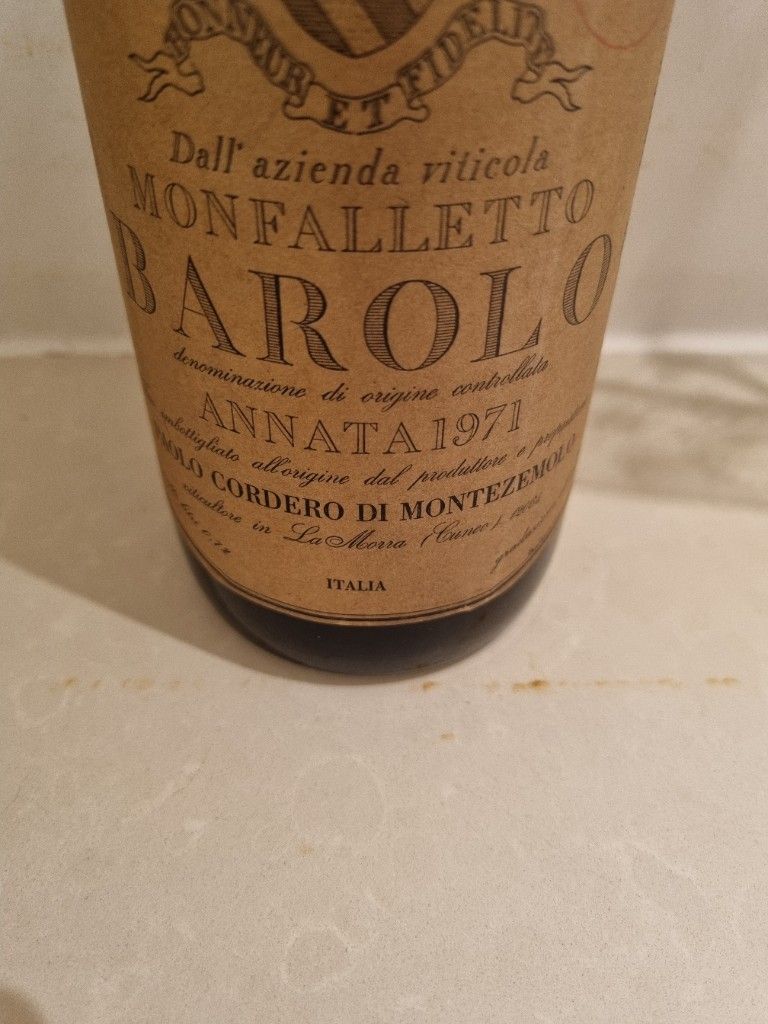
1971 Cordero di Montezemolo Barolo Monfalletto
Nebbiolo
Auction price: Register or sign-in to see quarterly averages
or visit the Wine Market Journal
Drink by: (Add My Drinking Window)
Advertisement
Popular Wines Like This
Who Likes This Wine(8)
-

enthusiastic_amat…
437 Tasting Notes
-
thewiz
4,341 Tasting Notes
-
Claret & CdP Gang
2,852 Tasting Notes
Community Tasting Notes (30) Avg Score: points
View all 30 Community Tasting Notes
What Do You Think? Add a Tasting Note
Pro Reviews
Professional reviews have copyrights and you can view them here for your personal use only as private content. To view pro reviews you must either subscribe to a pre-integrated publication or manually enter reviews below. Learn more.
View From the Cellar
-
By John Gilman
(Barolo “Monfalletto”- Paolo Cordero Montezemolo) Login and sign up and see review text.
Sep/Oct 2023, Issue #107, Recently-Tasted Italian Wines Autumn 2023, 9/1/2023

-
By Neal Martin
(Cordero Di Montezemolo Barolo Monfalletto Red) Login and sign up and see review text.
Vinous Table: The Harwood Arms, London, UK (Mar 2022), 3/1/2022, (See more on Vinous...)
NOTE: Some content is property of View From the Cellar and Vinous.
Add a Pro Review
Add Your Own Reviews:
Wine Definition
- Vintage1971
- TypeRed
- ProducerCordero di Montezemolo
- VarietyNebbiolo
- Designationn/a
- VineyardMonfalletto
- CountryItaly
- RegionPiedmont
- SubRegionLanghe
- AppellationBarolo
- Display optionsDefault
2/12/2024 - Claret & CdP Gang Likes this wine:
A lovely mature Barolo with no signs of decay, still retaining its fruits & body with panache!
Do you find this review helpful? Yes - No / Comment
1/7/2024 - enthusiastic_amateur Likes this wine: 91 Points
Fully mature showing oxidative, aged notes as expected. Tannins totally integrated, smooth body. Medium+ finish. Great acid. Double-decanted 5 hours prior to consumption.
1 person found this helpful, do you? Yes - No / Comment
1/7/2024 - gtilley wrote: flawed
Corked and completely clapped out anyway. You could tell there was some interesting pickled walnut and cherry aromatics going on underneath, but sadly undrinkable. I am increasingly cross with the charlatans who sold this to me on the promise of greatness. Sure, you have to take old bottles as you find them but all so far opened have been well and truly past it.
1 person found this helpful, do you? Yes - No / Comment
9/19/2023 - Claret & CdP Gang Likes this wine:
Ks’s bottle, opened for 2 hrs, still stinky & sour but blossomed at 3 hr mark, umami, soya, earth, still has acidity left, we were lucky tonight with the 71s - both were good
Do you find this review helpful? Yes - No / Comment
9/19/2023 - Claret & CdP Gang Likes this wine:
Lkh’s bottle, upon opening dead, after 2 hours complete revelation, Umami smell, soya sauce, really needed 2 hours, good body, evolving nose, minty at end, we opened 2 bottles of the same tonight both good but really needed the 2 hours airtime
Do you find this review helpful? Yes - No / Comment