
Tyrrells Private Bins - 2009 reds & 2010 whites
North Ryde RSL, Sydney
Tasted Saturday, September 4, 2010 by graemeg with 947 views
Introduction
These notes were taken during the Tyrrell’s masterclass at the public tasting in Sydney of the 2009 reds and just-released 2010 whites. Bruce Tyrrell hosted the masterclass and shared his insights on the wines and vintages. This was my first chance to taste some of the new single-vineyard wines Tyrrell’s are making from the six one-hundred-year-old vineyards they have access to (out of 11 still in the valley).
Flight 1 - The Semillons (4 Notes)
A warm early vintage. All whites were picked by January 31. Contrast this with 2000, where the last white grapes weren’t picked until March 6! The semillons were all the same light-yellow/greeny colour. It was a surprise to see so much colour in them – often the new release semillons are almost colourless. These are full, softer wines which will likely peak earlier than leaner, higher-acid vintages. They’re also relatively higher in alcohol. There’s no Belford semillon from 2010; the night before picking a hailstorm barely wider than the vineyard itself shredded the lot except from some chardonnay grapes at one end. There’s also the second release of the Johnno’s Semillon, hand-picked from a century-old patch of grapes, put through an ancient Burgundian hand-crusher and bottled in the old riesling-style bottles last used in the 80s with an appropriately retro label. No acid additions to these wines; I asked.
Tyrrell reckons the corner has really turned for Hunter semillon, which finally has a profile among afficionados worldwide; and he told some stories of people who’ve sought him out at wine fair in London last April to acclaim the style; el Bulli’s sommellier, Ernie Loosen and various others. He reckons the screwcap has been the making of Hunter semillon; the vast numbers of unreliably oxidised and disappointing bottles and that ghastly cork-pulling lottery are now a thing of the past.
Flight 2 - The Chardonnays (4 Notes)
Given that Tyrrell’s made Australia’s first commercial release of chardonnay in the 70s, it’s something of a shock to find 100-year-old vines sitting in the light sandy soils of the HVD vineyard. I guess they were just blended away in early years – or used for fortifieds! The 40th Vat 47 is a worthy wine, but the jewel in the crown is the HVD chardonnay – a staggeringly impressive offering.
Flight 3 - Pinot Noir (1 Note)
Surely one of the most capricious wines made in Australia. I think Murray Tyrrell only made it out of sheer bloody-mindedness in the end – after all, it was all these legendary Burgundies (of both colours) drunk at Bulletin Place in the 60s that seemed to push him into the burgundian quest, and when Tyrrell’s 1976 pinot won at the 1979 Gault-Millau ‘Olympics’ in Paris, that sealed the deal. Who said the Hunter is no good for pinot? That said, I think Bruce is wavering a little in his faith; vintage conditions have only let them make it three times in the last seven years, and he remarked that some of the pinot has been pulled out.
Flight 4 - Centenary Shirazes (3 Notes)
These wines sit at the extreme end of shiraz styles in Australia. Hundred-year-old dry-grown shiraz, new French oak, and tiny production (~250-300 dozen) often conjures up images of inky South Australian ooze-monsters. These are lighter-bodied wines from two of Tyrrell’s own centenary vineyards and the 140-yo vines in the Stevens vineyard. They rely on (natural) acid for their profile, not alcohol or tannin. Being acidic doesn’t preclude ripeness, or depth of flavour, but it does leave them well out of the mainstream of modern Australian shiraz. The barrel might be new, but it’s a single 2700l cask in the case of Johnno’s; or for 4 Acres, a 2yo 2700l cask and a new 1500l one. These wines are a deliberate throwback to the old politically incorrect days when the Hunter made ‘Burgundy’; sensually seductive wines and not the assertive ‘Hermitages’ and ‘Clarets’ of McLaren Vale and Coonawarra.
These are fascinating wines; surprisingly drinkable now, but it’s easy to imagine them being disappointing, if you are used to the typical modern shiraz. In a line-up of wines – like a show competition – these would be utterly lost. They inhabit a different universe altogether. In a world of Mahler symphonies, they represent Sibelius’ Seventh. Wines from these vineyards were used by Maurice O’Shea’s for his legendary wines, and the grapes also went into the great Lindemans wines of the 50s. Lighter-bodied warm climate reds. Welcome back.
Flight 5 - Vat Reds (4 Notes)
After the totally washed-out 2008 vintage, the regulars are back, and in fine form. The prices have jumped; Tyrrell made some reference to knocking off Brokenwood’s Graveyard shiraz in the Hunter Valley Wine Show (one of the few shows Tyrrell’s enter their reds in) a couple of years running, so I guess they feel justified in lifting the entry price – when Graveyard is at or beyond the $100 mark. On the other hand, Graveyard’s got 20+ fairly consistent years behind it, whereas Tyrrell’s seemed to let their reds get awfully dirty and fungal around the turn of the last century. For them, this is something of a new age.
Closing
Instructive tasting. The most excitement for me revolved around the single vineyard reds and the HVD chardonnay. The 2010 vintage for reds is looking similar to 2009, which no-one ought to complain about.
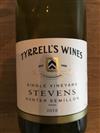
2010 Tyrrell's Sémillon Single Vineyard Stevens
Australia, New South Wales, Hunter Valley
{screwcap, 11%, A$22} Yellow-green. The first-picked of the semillons, this has a pronounced nose of limes, citrus and a flowery note. Pronounced in the context of Hunter semillon, and for the vintage; it doesn't leap out like a Clare riesling or a NZ sauvignon. The palate is dry, with plenty of tingly acid, sweetly full and rich fruit in a light-medium bodied way and a medium length finish. Youthfully fresh and really quite flavoursome. There's a little grassines, but it's mostly citric - not overdone or unbalanced though. A warm-vintage early drinker.
Post a Comment / Do you find this review helpful? Yes - No
2010 Tyrrell's Johnno's Sémillon
Australia, New South Wales, Hunter Valley
{screwcap, 11.5%, A$35} Hand picked & bunch selected, hand-crushed; a return to the simplest, oldest techniques of all. The nose is soft and grassy, almost a touch sweaty, with a submerged citrus quality. It has a really perfumed note to it, which almost comes through texturally on the palate. Little yellow flowers, a dash of hay, a touch of blossom; there are lots of glimpses of fruity charaters on the palate, all swathed in a cuddly sort of acid. It's only light-medium in weight, but the real quality giveaway is the evenness with which these subtle flavours cover all the palate, and the persistence with which they cling to form the finish. The magic trick is how something this light can be so rich too; it's not sugar and it's not oak that do it, because there are none of those. It's a cut above the Stevens, and more drinkable now than the Vat 1. Probably not for the very long term, though; old habits say it's too rich now for that...
Post a Comment / 2 people found this helpful, do you? Yes - No
2010 Tyrrell's Sémillon Vat 1
Australia, New South Wales, Hunter Valley
{screwcap, 12%, A$35} The biggest, richest Vat 1 (look at that alcohol!) for many a year. The assertive straw & citrus aromas don't preclude a distinctly steely note from underpinning the nose, but it's still a very fruity rich Vat 1. Certainly there's a acidic spine that runs the length of the palate, which more than carries the straw-like fruits, so there's no need to fear too much for the wine's longevity (the 1992, also 12%, is still at peak drinking in my experience). But the flavours are quite full, and as with Johnno's, they coat all parts of the palate. This is a bigger, tighter wine, although I still wouldn't mark it as much more than light-medium bodied. Less interesting to drink now, but ought probably live a little longer than Johnno's. Worthy wine.
Post a Comment / 1 person found this helpful, do you? Yes - No
2010 Tyrrell's Sémillon Futures
Australia, New South Wales, Hunter Valley
{screwcap} From the HVD vineyard this year. Yellow-green. Slightly greasy-smelling nose of grass, straw and hay. A medium bodied palate, of near-medium weight, with a rather fat & flowery palate, a touch of greasiness to the texture (although it's not lacking acid), and a medium length finish. Fuller-bodied than the other semillons, and perhaps not so sharply focussed. OK wine.
Post a Comment / Do you find this review helpful? Yes - No