
Robert Mondavi Cabernet Sauvignon Retrospective: 1978-1987
eVe Restaurant, Berkeley, California
Tasted Thursday, April 7, 2011 by rjonwine@gmail.com with 2,793 views
Introduction

This was a fun and informative look back at older vintages of Cabernets from one of the most influential makers of Napa Cabernet Sauvignon in the '70s and '80s--Robert Mondavi. Fred Swan of NorCal Wine organized this retrospective tasting, based on wines he had collected. He booked an excellent new restaurant in Berkeley for it, eVe. He was able to commandeer the entire restaurant for the evening, so that we could do the vertical tasting first, with commentary from Mondavi's wine educator Mark de Vere, MW, whom Fred had invited to participate in the tasting. We then had a delicious, inventive, three-course dinner prepared by eVe's owner/chefs, Christopher and Veronica Laramie, with some additional, more recent vintages of Mondavi wines that Mark brought along.
In the '70s, Robert Mondavi was a powerhouse. California critics lauded him for bringing new techniques from Bordeaux and elsewhere, and imagined a limitless horizon for Mondavi and his sons. A typical piece in Clifton Fadiman and Sam Aaron's The Joys of Wine, published in 1975, rhapsodized, "Robert Mondavi's Cabernet Sauvignon is often served at the White House and at dinners given by the State Department. This stamp of approval and the accompanying publicity have made it the single most sought-after red wine of the Western Hemisphere. Perhaps within another generation the equivalent of a Lafite-Rothschild will be born at the Mondavi winery." Thirty-six years later, we know that Mondavi's empire got way over extended, requiring its sale to Constellation Brands in 2004 to get the Mondavi family out from under a crippling load of burgeoning debt. These wines, however, were from when Mondavi was still riding high--starting with the 1978 vintage, the year before the Opus One project with Baron Philippe de Rothschild of Château Mouton Rothschild was announced.
For our flight of mature Mondavi Cabs, we tasted either the Reserve Cab or the regular bottling for each year, from 1978 through 1987, with the exception of 1983. For 1980, we tasted both the regular and Reserve bottlings. My favorites were the 1979 and 1982 Reserve bottlings. We then followed with a jump ahead, over dinner, to two more recent Cabernet vintages: 1997 and 2007. The contrast between the 2007, at 15.9% alcohol, and the older vintages, which ranged from 12.5 to 13% alcohol, couldn't have been more stark. The 1997, too, represented a step in this evolution--to more concentrated, ripe, high alcohol, "Parkerized" Cabs--with its 13.5% alcohol. But the '07 was full throttle, plush, with gobs of berry and blackberry fruit. It was actually quite tasty for a Cab in the concentrated, fruit forward style, but it's hard to imagine it aging as gracefully as most of our older wines had. I very much liked the '03 Reserve Fume Blanc that Mark de Vere also added into the tasting, and it went extraordinarily well with the smoky sturgeon course I had. We ended with a botrytised Sauvignon Blanc that Mark brought, which was very lush, but which lacked the acidity I really value in the best sweet wines.
I commend Fred for organizing this instructive retrospective, and thank him very much for including me in this very enjoyable wine and food occasion. For more details about the vintages and individual wines, and video clips of Mark de Vere introducing our tasting and summing up at the end, see the flight and tasting notes below. Mark also thoughtfully provided us with copies of vintage summaries and production details for many of the bottles in our older Cab flight, so the details below regarding cepage and alcohol levels derive from those summaries.
Flight 1 - Bubbly Starter (1 Note)

Fred Swan of NorCalWine.com
Here's a clip of Mark introducing our vertical tasting, including his description of the To Kalon Vineyard. My deepest apologies for the poor lighting on Mark's face, due to the high level of backlight from the restaurant's windows while Mark was speaking.
[youtube]CWiZZsZjeBY[/youtube]
Flight 2 - 1978-1980 (4 Notes)

This was my favorite grouping over all. The '78 Reserve represented that very warm vintage with a roasted quality to the mature fruit and relatively high alcohol for the period (13%), but delightful autumnal notes at this point in its evolution. The following year, 1979, saw uneven flowering, and a fairly cool growing season, with hot spells toward the end. The '79 Reserve was my favorite of this group. It had the highest Cab Franc percentage of any our wines except the '87, at 5.6%, and rather intense eucalyptus flavors on the nose and palate, which I quite enjoy in Napa Cabs. Mark speculated that the eucalyptus was probably even more obvious in 1979, as that was the first year of Opus One, when it was made from selected barrels primarily from Mondavi's To Kalon Vineyard. According to Mark, Château Mouton Rothschild winemaker Lucien Sionneau, who made the Opus One wines with Robert Mondavi’s son Timothy, did not like the eucalyptus flavors, so would have selected more To Kalon barrels for Opus One that didn't have that quality, leaving more eucalyptus scented barrels for the '79 Mondavi Reserve. Eucalyptus trees are planted around the To Kalon Vineyard, and grapes planted near those trees acquire some of the eucalyptus oil from leaves and berries that fall from the trees, passing those flavors on to the wine. The 1980 Opus One was also made from To Kalon fruit, and I detected menthol qualities in our two '80 bottlings as well, but not as strongly eucalyptus in nature as the '79. The '80 regular bottling did seem much more advanced in evolution than the '80 Reserve. They both came from a very cool, long growing season. 
Flight 3 - 1981-1984 (3 Notes)

The 1982 dominated this grouping for me. It also had eucalyptus on the nose, with menthol and mint on the palate, and admirable structure with lively acidity. That vintage included a warm summer, but harvest-disrupting storms in mid- to late September. The 1981 was also very good, with roast coffee flavors showing on both the nose and palate, along with mature beef jus flavors. 1981 had an unusually hot and dry summer, with some uneven ripening, and an unusually early harvest. The 1984 was the weakest of this group for me, with a stewed quality to the fruit. That growing year had gotten off to an early start, with a very warm Spring causing early bud-break, and harvesting beginning mid-August, after the shortest growing season on record. September was also very hot, so delays in picking had a tendency to lead to overripeness, which I seemed to be picking up in the stewed fruit.
Flight 4 - 1985-1987 (3 Notes)

The 1985 regular bottling was the strongest in this grouping for me, the result of a nearly ideal, cool and long growing season. It was also the year that Tim Mondavi started experimenting with extended maceration of the Cabernet Sauvignon. The 1987 was my second favorite of this group, again the result of a cool growing season with low rainfall and an early harvest. The 1986 Reserve, which we had from magnum, was the weakest of this group for me, with a plusher mouthfeel, higher concentration and seemingly higher alcohol (although it was labeled as only 12.9%), marking it as a forerunner of the ripe, lush, high alcohol style that we met foursquare in the 2007. 1986 started out with wet weather, frost and mildew, but a sunny August and cool and long growing season ensured that the Cabernet fully ripened.
Here's Mark summing up our vertical:
[youtube]fsA1ii3Wq0k[/youtube]
Flight 5 - Fumé Blanc Reserve (1 Note)
This Reserve Fumé Blanc was quite delicious and well balanced, and reminded me quite a bit of a riper white Bordeaux, even though it only has 5% Semillon. I had the good fortune a week and a half after this tasting to try an '03 Mondavi Sauvignon Blanc from To Kalon's B Block, and it was holding up well and reminded me even more of very good white Bordeaux.
Here's Mark's background on Mondavi's Fumé Blanc:
[youtube]Ojz4DXVNq_U[/youtube]
Risotto with squid ink, black radish, togarashi and kumquats
Onsen egg with bacon dashi, brown rice, yam leaves and black garlic
Flight 6 - 1997 & 2007 Mondavi Reserve (2 Notes)

For our last Cabs, thanks to Mark, we got to try two Reserve bottlings ten years apart. Both were good, but in a style that was clearly evolving toward the more concentrated, higher alcohol style that Napa Cabs have been known for now for the past 10 to 15 years. Being able to compare the former Napa style to the current one, and to see how relatively well the wines made in the former style were aging, made me wish even more fervently for a return to the more elegant, balanced, structured Cabernets of Napa's glorious past. It also reminded me of why the only Cali Cabs I collect these days are those still made in that style, like Ridge's Monte Bello.
Sturgeon with bay leaf foam, black trumpet mushrooms, vanilla and horseradish
Flight 7 - Sweet Finish (1 Note)

eVe Pastry Chef/Owner Veronica Laramie
Dark chocolate mousse with Thai tea ice cream, amaranth, coconut and lucuma
Closing

eVe Chef/Owner Christopher Laramie
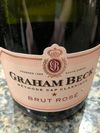
NV Graham Beck Brut Rosé 88 Points
South Africa, Western Cape
Light pink orange color; intense, tangerine, tart orange, floral nose; creamy textured, ripe orange, tangerine palate with medium acidity; medium finish
Post a Comment / Do you find this review helpful? Yes - No