
2011 Rioja Grand Tasting: 197 wines from 63 producers
Westin St. Francis, 32nd Imperial Floor, San Francisco, California
Tasted Monday, May 2, 2011 by rjonwine@gmail.com with 4,595 views
Introduction

morning seminar
This was an admirably well produced and organized event. It started with a morning tasting seminar, featuring 10 well chosen Tempranillos, of different styles from different producers, a couple of whom were featured on our seminar panel. The panel was moderated by Philadelphia-based wine consultant and wine educator Marnie Old. A very informative pamphlet was prepared for the seminar, and a thoroughly well organized and helpful tasting book was created for the grand tasting as well. There was enough time in the course of the five-hour grand tasting for me to get to nearly every producer, and to try virtually everything that was poured--a total of 197 wines from 63 producers. There was also a little food available during the short break between seminar and grand tasting to help create a base on which to taste (and spit) a vast quantity of wines. And, very generously, there was a bag of "swag" for participants, which included a "Vibrant Rioja" chef's apron, Vibrant Rioja pen, Vibrant Rioja key chain and a video about Rioja wines. For a wine region looking to educate and make an impact on a lot of tastemakers of the American wine market, this was a job well and effectively executed.
The overall effect of the day was to remind me what a food friendly wine Spanish Tempranillo is. It is lighter bodied than most big red wines these days, which, like lighter bodied Pinot Noir, makes it work with a wider variety of foods. The Spanish tradition is to age Tempranillo both in barrel and bottle for many months, which softens some of the tannins that otherwise make a lot of young reds a terrible choice with food. That being said, I note that my point scores were generally in the mid- to high-80s for the vast majority of the wines in the grand tasting. I need to emphasize that this doesn't mean I didn't like them. Far from it. It simply means, for me, that many of them lacked the complexity that I look for in wines that I score 90 points and higher. I quite enjoyed the wines that I scored from, say, 87 to 89 points, and would definitely enjoy them with a wide variety of food. They are well made, light-medium bodied, and clearly convey a terroir sense of barrel and bottle aged Tempranillo from Rioja. They are also, generally, a wine bargain, ranging in price, for the most part, from $10 to $23. The ones that I scored from the mid- to high-80s simply lacked the complexity on the palate and tannic structure requisite for aging that I look for in red wines to which I can give 92 or more points. But these are highly enjoyable wines on the whole. A few of them were showing more of the American (and sometimes French) oak vessels that they are fermented and aged in than I care for in wines that I can pair with food, which caused me to grade them lower than 85 points. And a few were just not balanced or particularly good at all. The vast majority, however, were admirable products of a long Spanish tradition, and it was great to be able to taste a wide selection of them, from similar vintages, from such a vast array of Rioja producers. Like an intense foreign language experience, this was indeed a total immersion in the essence of wine from Rioja.
Ninety percent of the vineyards of Rioja are planted to red varieties, and 85% of Rioja's red vines are Tempranillo. There are a few other red grapes also grown: traditionally Garnacha (Grenache), Graciano (France's Mourvèdre), and Mazuelo (Carignan), with more recent experimentation also going on with Cabernet Sauvignon. The dominant white grape is Viura (known elsewhere as Macabeo), along with lesser amounts of Malvasia and Garnacha Blanca. A new entrant amongst white varieties, which we got to taste a sample of at the seminar, is a mutated green-skinned version of Tempranillo, called Tempranillo Blanco. It was discovered in 1988 by a grower in the village of Murillo de Rio Leza. DNA typing verified that it is truly Tempranillo, but an albino variant with green-gold pigmentation rather than blue-black. It was propagated and studied for two decades, and only recently approved for use in Rioja. We tasted an example from Bodegas Valdemar, their 2010 Inspiración, which was aged for 12 months on its lees in 100% French oak barrels. It suggested a cross between a dry Pinot Gris and a tasty white Bordeaux. It had a touch of the oily texture I often get in white Bordeaux, with its Semillon component, and a complex mix of tart peach, quince, green fruit and mineral flavors. I rated it 92 points. It's pricey at $35, which reflects its relative rarity at the moment, but based on this sample, it seems like a very promising new variety for the region.
A distinctive feature of Rioja wines, besides the dominance of Tempranillo, is the barrel maturation. The 225-liter "barrica bordelsa," which was introduced in the mid-1800s, is required by DOCA regulations. Those regulations also specify minimum aging periods for each official category of wine. Red wines labeled Crianza and Reserva must be aged at least one year in oak, and at least another year in bottle. Gran Reservas are required to spend at least two years in barrel, and three years in bottle. Many producers age their wines in oak for much longer than these requisite minimums. American oak barrels, with their distinctive vanilla and dill flavors, are the most common, but tighter grained French oak is coming into increasing use, with many producers using a mix of new and used American and French oak barrels.
My favorite wines of the day, those that I rated 91 points or higher, came from a total of ten of the 63 producers. These included some of my longtime favorite Rioja producers, including Marqués de Murrieta, Muga and the distinctive, long-aged-before-release López de Heredia. My top ten producers in the tasting, with at least one wine rated 91 points or higher, were:
Contino
EgoMei
Faustino
Viña Herminia
López de Heredia
Marqués de Cáceres
Marqués de Murrieta
Muga
Valedmar (Martinez Bujanda), and
Viñedos de Páganos
Other producers that presented good quality, well made Riojas in the 88 to 90 point range, and that offer very good values included:
Finca Allende
Castillo de Cuzcurrita
Dinastía Vivanco
Federico Paternina
LAN
La Rioja Alta
Luis Cañas
Marqués de Riscal
Ontañón
Remelluri
Remírez de Ganuza, and
Ysios
My favorite whites, scoring 91 points or more, were
2001 López de Heredia Blanco Crianza Viña Gravonia - 93+ points
2010 Bodegas Valdemar (Martinez Bujanda) Tempranillo Blanco Inspiración - 92 points
My favorite rosé, or rosado, was the 2009 Faustino Rosado Faustino VII - 91 points
My favorite reds, scoring 91 points or higher were:
2005 Contino Reserva - 91 points
2007 EgoMei - 91 points
2005 EgoMei Alma - 92 points
2006 Viña Herminia Excelsus - 91+ points
2002 López de Heredia Reserva Viña Bosconia - 91+ points
1991 López de Heredia Gran Reserva Viña Tondonia - 93+ points
2008 Marqués de Cáceres "MC" - 91 points
2001 Marqués de Murrieta Castillo Ygay Gran Reserva Especial - 92 points
2004 Bodegas Muga Gran Reserva Prado Enea - 91 points
2004 Bodegas Valdemar (Martinez Bujanda) Conde de Valdemar Reserva - 91 points
2004 Bodegas Valdemar (Martinez Bujanda) Inspiración Edición Limitada - 91 points
2007 Viñedos de Páganos Rioja La Nieta - 92 points
2007 Viñedos de Páganos Rioja El Puntido - 91 points
I again congratulate and applaud the producer of the event, the Consejo Regulador de la Denominacion de Origen Calificada (DOCa) Rioja, for the terrific organization and comprehensiveness of this tasting. Their program indicates that this is the "1st annual" Rioja grand tasting in San Francisco, and I look forward to their return for many more years to come. For more on the producers and wines represented, see my detailed tasting notes below.
Flight 1 - Allende (3 Notes)

Flight 2 - Antaño (1 Note)
Flight 3 - Antiguas Viñas de Rioja (3 Notes)

Flight 4 - Artadi (1 Note)
Flight 5 - Baron de Ley (2 Notes)
Flight 6 - Berberana (3 Notes)
Flight 7 - Beronia (5 Notes)
Flight 8 - Bilbainas (4 Notes)

Flight 9 - Bretón (2 Notes)
Flight 10 - Campillo (2 Notes)
Flight 11 - Campo Viejo (3 Notes)
Flight 12 - Castillo de Cuzcurrita (2 Notes)
Flight 13 - Conde de Hervias (1 Note)
Flight 14 - Conde de Jauregu (1 Note)
Flight 15 - Contino (1 Note)
Flight 16 - Corral (2 Notes)
Flight 17 - C.V.N.E. (Cune) (6 Notes)
Flight 18 - Dinastía Vivanco (5 Notes)
Flight 19 - EgoMei (2 Notes)

Flight 20 - El Coto (4 Notes)
Flight 21 - Faustino (7 Notes)
Flight 22 - Federico Paternina (5 Notes)
Flight 23 - Franco-Españolas (6 Notes)
Flight 24 - Hermanos Peciña (2 Notes)
Flight 25 - Herminia (5 Notes)

Flight 26 - Ijalba (2 Notes)
Flight 27 - Jorge Ordoñez (1 Note)
Flight 28 - Labastida (4 Notes)
Flight 29 - LAN (6 Notes)
Flight 30 - Landaluces (2 Notes)
Flight 31 - La Rioja Alta (4 Notes)
Flight 32 - López de Heredia (4 Notes)

Flight 33 - Luberri (2 Notes)
Flight 34 - Luis Cañas (6 Notes)
Flight 35 - Marqéus de Carrión (2 Notes)
Flight 36 - Marqués de Cáceres (8 Notes)
Flight 37 - Marqués de la Concordia (3 Notes)
Flight 38 - Marqués de Murrieta (3 Notes)


Flight 39 - Marqués de Riscal (3 Notes)
Flight 40 - Martinez Bujanda (5 Notes)
Flight 41 - Montecillo (2 Notes)
Flight 42 - Muga (4 Notes)

Flight 43 - Muriel (4 Notes)
Flight 44 - Ontañón (2 Notes)

Flight 45 - Ostatu (1 Note)
Flight 46 - Pagos de Valdeorca (1 Note)
Flight 47 - Palacio (4 Notes)
Flight 48 - Palacios Remondo (4 Notes)
Flight 49 - Ramirez (2 Notes)
Flight 50 - Remelluri (1 Note)
Flight 51 - Remírez de Ganuza (2 Notes)
Flight 52 - Riojanas (6 Notes)
Flight 53 - Santiago Ijalba (5 Notes)
Flight 55 - Sierra Cantabria (3 Notes)
Flight 56 - Solar de Randez (3 Notes)
Flight 57 - Torre de Oña (2 Notes)
Flight 58 - Valdemar (Martinez Bujanda) (4 Notes)


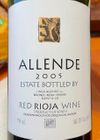
2005 Finca Allende Rioja Allende 87 Points
Spain, La Rioja, Rioja
Ripe berry, oak, plum nose; ripe berry, oak, plum, cedar palate; medium finish 87+ points (100% Tempranillo)
Post a Comment / Do you find this review helpful? Yes - No
2005 Finca Allende Rioja Calvario 90 Points
Spain, La Rioja, La Rioja Alta, Rioja
Dark purple red violet color; oak, cedar, plum nose; plum, cedar, oak palate; medium-plus finish 90+ points (90% Tempranillo, 8% Garnacha, 2% Graciano)
Post a Comment / Do you find this review helpful? Yes - No
2007 Finca Allende Rioja Aurus 90 Points
Spain, La Rioja, Rioja
Deep berry, vanilla nose; deep berry, molasses, black fruit palate; medium-plus finish 90+ points (85% Tempranillo, 15% Graciano)
Post a Comment / Do you find this review helpful? Yes - No