
d'Arenberg Grenaches and Grenache blends blindtasted
Tom's House, Palo Alto, CA
Tasted Monday, February 4, 2008 by rjonwine@gmail.com with 608 views
Introduction

Introductory comments by tasting organizer Ross Bott:
Grenache is the major varietal component of all of all Chateauneuf du Papes, and many of the best cuvees are nearly 100% old vine Grenache. Based upon this varietal's potential to produce world class wines, many of the first European immigrants who settled in the McLaren Vale in Australia in the last half of the 1800s planted Grenache in their vineyards. Many of these 100+ year old vineyards still exist today.
During the mid-twentieth century, Grenache fell out of fashion in Australia. This was partially because many Grenache grapes from South Australia ended up in inexpensive fortified wines, and people began to associate the varietal with mediocrity. This reduced demand for Grenache grapes, and in turn meant that much of the rest of the Grenache vineyards were overcropped, producing table wines that were at best uninspiring reds. This downward spiral continued until the beginning of the 1990s.
d'Arenberg Cellars was founded in 1927 in the McLaren Vale, and many of the early vineyards that they inherited were planted to Grenache. Over the following decades, d'Arenberg experimented with Grenaches, but they were largely ignored by Australian wine drinkers. In 1993, winemaker Chester d'Arenberg, realized the potential of the varietal to produce world class wines especially if taken from low-yielding, old vine vineyards, but needed more vineyard owners to treat their Grenache vineyards seriously.. So he make a then unheard of offer to the small McLaren Vale growers around the winery -- he would buy their grapes at double the price of any other winery's offer if they would cut back yields and let the grapes ripen to full maturity. The resultant Grenache-based wines and Grenache-Syrah-Mourvedre (GSM) blends were outstanding, and started a Grenache revival which quickly extended to other wineries in the McLaren Vale and Barossa Valley. d'Arenberg continues to play the role of protective angel for old-vine Grenache, and have named their Grenache wine "The Custodian" in reflection of this.
d'Arenberg makes three other Grenache-dominated wines. Two are Grenache blends: "d'Arry's Original," a 50-50 blend of Grenache and Shiraz, and "The Ironstone Pressings," a GSM which is about 70% Grenache. The latter is named after large pieces of rusty, red-brown Ironstone (a variant of granite) which litter the vineyard, and is essentially their reserve bottling meant to compare to a top-end Chateauneuf.
There is also a pure Grenache called "The Derelict", named after the vineyard from which it was made, which had falled into disuse. The vineyard was turned into a horse farm, and horses both trampled the vines and nibbled on the new shoots. When d'Arenberg discovered the vineyard in 2000, "The vines themselves resembled Medusa's hair -- wild, thick, struggling and gnarled." The first vintage of this vineyard under the d'Arenberg label was 2002, and the vineyard produces wonderfully deep, pure Grenache.
Tonight, we'll try a collection of d'Arenberg Grenaches and GSMs from 1996 through 2004, including examples of The Custodian, d'Arry's Original, The Derelict" and "The Ironstone Pressings."
Flight 1 - pre-tasting blind wine (1 Note)

Flight 2 - My TNs and group scoring (6 Notes)

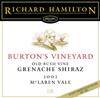
1998 Richard Hamilton Old Bush Vine Grenache Shiraz Burton's Vineyard 92 Points
Australia, South Australia, Fleurieu, McLaren Vale
Red violet color; berry and pepper nose; tasty, mature, pepper, berry and black fruit palate; medium-plus finish
Post a Comment / Do you find this review helpful? Yes - No