
External search Google (images) Wine Advocate Wine Spectator Intl. Wine Cellar BurgHound WineZap Vinquire Wine-Searcher
Vintages 2009 2008 2007 2006 2005 2004 2003 2002 2001 2000 1999 1998 1997 1996 1993 1988 1985
From this producer Show all wines All tasting notes
|
| Drinking windows, Wishlists and Values |
| Community Tasting History |
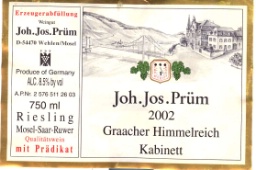
| Community Tasting Notes (average 89.2 pts. and median of 90 pts. in 23 notes) | | | Tasted by wineglas on 3/15/2010 & rated 90 points: Medium gold. Nose a little petrol, peach, slate and honey. On the palate a touch of sweetness with pinneapple, peach, petrol, and slate. Medium finish and really refreshing. Drinking really well right now. (307 views) | | | Tasted by jmht on 7/19/2009 & rated 90 points: Delicious, similar to prior tasting. Crisp green apple, lime, slate, balanced, hint of spritz. May improve yet, but delicious now. (486 views) | | | Tasted by chbeaumont on 6/21/2009 & rated 90 points: Starbright, fairly heavy spritz; kerosone, hessian, wet stones, low keyed - later chalky; off dry, marked acidity - youthful, tight as a drum; clean as a whistle. Dry, forceful finish, extended length. Needs years. (517 views) | | | Tasted by Susanville43 on 1/1/2009 & rated 89 points: Very pale yellow, more bubbley than usual. Nice nose of mineral. Lime and green apple on the palate. A refreshing wine that went well with our stir-fry. (598 views) | | | Tasted by JeffGMorris on 12/5/2008 & rated 91 points: AP #12-03. Almost colorless, like many young Prums. Very spritzy with a lively acidity.Medium bodied and quite fragrant with aromas of green apples, lime and slate. Long finish, particularly for a young wine. Tasted quite young but somewhat open at the same time. While I don't think this will ever have the depth of the '01, '03 or '05 Prums I think a few more years in the bottle will yield further rewards for the palate. 50+13+12+8+8 = 91+ (466 views) | | | Tasted by jmht on 9/13/2008 & rated 90 points: WOTN. Nose of lime and slate. Palate of lime, spritz, minerals, slate, long, cool finish. Light and substantial at the same time. I don't think it has longevity of wehlener, but probably will continue to evolve/improve over 5 years... certainly, very enjoyable now. (595 views) | | | Tasted by MauriceE on 8/24/2008 & rated 92 points: This wine is so elegant and light, you risk to miss the sheer quality of it. The characteristic "petrol" nose, extreme minerality, it's all there. This is very, very good. No need to think of what to serve next to it, just the wine is interesting enough to sniff and taste. Excellent. (623 views) | | | Tasted by Spencer on 1/27/2007 & rated 92 points: Excellent - to me a true 'kabinett' style wine. Balanced, with great, ripe acids. Liquid stone on the palate, with a hint of yeast. Slightly spritzy as well. This could use some more age, and will last a long time. Long, complex finish. (1237 views) | | | Tasted by chbeaumont on 7/31/2006 & rated 85 points: Heavy spritz, pale of course; gunflint, smokey edge, hint of freesias, developing a slatey note; off dry, grapey, nectarines, refr acidity (just); not a long distance runner. Fair length only. (800 views) | | | Tasted by Lukeout on 7/11/2006: may have been a bit oxidized, but seemed "off" the first night. It also had an amazing amount of trapped CO2, my wife's glass could have been mistaken for a bubbly! Day 2 and 3 though really showed some finess with nice apricot and green apple. (1231 views) | | | Tasted by chbeaumont on 7/3/2006: Heavy spritz, pale of course; gunflint, smokey edge, hint of freesias, developig a slatey note; off dry, grapey, nectarines, refr acidity (just); not a long distance runner. Fair length only. 14 (818 views) | | | Tasted by Tad GW on 5/25/2006 & rated 89 points: I don't generally like wines this sweet but this one was an exception. Would work very well with food such as exotic asian or Indian foods and enjoyable with fish too. Fruity and rich it was a pleasure to drink. I'll have to try some more German wines. Maybe I'll find others I like.
50+5+11+15+8=89 (1627 views) | | | Tasted by thebonnydooner on 4/1/2006 & rated 87 points: Very nice - but not that exciting. Very pale, has a soft apple, pear fruit nose with only a little petrol and white flower hints. Nicely balanced on the palate, juicy with crunchy apple and pear acidity. Nice finish. I would want more acidity I was going to age this.
Restasted the remainder on 3 days later and confirmed the above - did not gain much complexity, remained a very nice, very drinkable Kabinett. (1773 views) | | | Tasted by Anonymous on 3/3/2006: delicious lemony zest, petrol, great acidity and nice long finish. very nice wine. (1693 views) | | | Tasted by mouton45 on 2/1/2006 & rated 88 points: (1370 views) | | | Tasted by Eric on 1/23/2006: Dinner with friends (Seattle, WA): This bottle had been open for more than a day, but it was singing. Less 'Young Mosel Stink' than a bottle enjoyed two days earlier at a different tasting. Crisp, clean and delicious, more of a true Kabinett than examples from 2001 and 2003. Lovely. (2467 views) | | | Tasted by Eric on 1/21/2006 & rated 88 points: Seattle Tasting Group does Aussie Shiraz (Bellevue, WA): AP #12. Ahh, what a nose. Talc, lots of sulfur and that young stinky minerality of the Mosel. The palate is zingy and vibrant although pretty lean and razor like. Quite nice! (2207 views) | | | Tasted by Stephan O. on 4/11/2005 & rated 90 points: This Kabinett has an unremarkable nose, which shows only the faintest hints of citrus and maybe white bread. The palate, though, is much more interesting, with a restrained bit of sweetness on the attack and then turning to pear, yeast, and mineral as it moves onward. The minerality is especially pronounced on the finish, which is long and concentrated for a wine without much heft (and only 8 per cent alcohol to boot). I enjoyed this one quite chilled, although that probably submerged the already minimal amount of fruit. (1968 views) | | | Tasted by Anonymous on 12/3/2004 & rated 90 points: Found this wine to be very nice. Aroma of white fruits, very fruit foward on the the taste and nice minerality on the palate. Went very well with King Crab (2045 views) | | | Tasted by Anonymous on 10/17/2004: 2 576 511 26 03 (2045 views) | | | Tasted by Richard Jennings on 7/8/2004 & rated 89 points: Clean, mineral nose; tasty, ripe grapefruit, mineral palate; medium finish (418 views) | | | Tasted by kstoddard on 4/30/2004 & rated 90 points: (773 views) | | | Tasted by Anonymous on 3/28/2004 & rated 85 points: Last bottle as a single man. The nose was very faint was some minerality and custard. The palate had a lot of lively acid and tastes of dough, wet slate, and lemons. There seems to be a lot of fruit hiding below the surface. (1767 views) |
| Producer website | Importer website | More information on Prüm Goldkapsel wines
Definition of "white wine" at Epicurious.com
Varietal character (Appellation America) | A short history of Riesling (Uncork) | Riesling (wikipedia)
Lowest must sugar content of Prädikat designation resulting in light wines, typically semi-sweet with crisp acidity.
Der Weinort Graach und seine Weinlagen
Der Weinort Graach, moselabwärts neben Bernkastel-Kues gelegen, wird erstmals im Jahre 975 in einer Urkunde des Trierer Erzbischofs Theoderich (965-977) erwähnt. Der Ortsname "Graach" selbst ist keltischen Ursprungs und weist auf die Besiedelung des Moseltales durch den keltischen Stamm der Treverer im 5. Jahrhundert v.Chr. hin. Daß Graach eine ehemals bedeutende keltische Siedlung gewesen sein muß, belegen Ausgrabungen aus jüngerer Zeit, die auf der Moselhöhe über dem Ort einen keltischen Tempelbezirk freigelegt haben.
In Graach, das zu den größten Weinbaugemeinden des mittelalterlichen kurtrierischen Staates zählte, hatte die Geistlichkeit umfangreiche Besitzungen. Nach einer Aufstellung aus dem Jahre 1720 gehörten der Kirche 25% der Gemarkung; zusammen mit einigen ritterschaftlichen Besitzungen waren ein Drittel der Graacher Weinberge in grundherrschaftlichem Besitz. Noch heute zeugen die verbliebenen Weinbergsnamen Himmelreich, Dompropst, Abtsberg und Josefshof von diesen engen Bindungen zu den geistlichen Feudalherren.
Wie überall an der Mosel begann der Aufschwung des qualitätsorientierten, bürgerlichen Weinbaues mit der Säkularisation des Kirchenbesitzes durch den Reichsdeputationshauptschluß 1803, als ein Großteil des geistlichen Besitzes für billigstes Geld veräußert werden mußte. Die Eingliederung des Moselgebietes in das Königreich Preußen brachte wirtschaftliche Blüte und veranlaßte viele, nunmehr zu Grundeigentum gekommene Winzer, ihre Weinberge mit Rieslingreben zu bepflanzen, die bessere Qualitäten bei geringeren Mengenerträgen brachten, als die zuvor verwendeten Kleinbergerreben. Der Ruf der Graacher Weine konnte sehr schnell Anerkennung finden und bereits 1837 schrieb Christian von Stramberg , der Klassiker unter den Weinautoren, Graach produziere einen der edelsten Moselweine.
Der Graacher Weinberg selbst ist Teil des mächtigen, rechts der Mosel gelegenen Schieferhang-Massives, das sich von Bernkastel über Graach und Wehlen bis nach Zeltingen hinstreckt und eine Fülle weltbekannter Rieslinglagen aufweist: den Berncasteler Doctor, die Badstube, Graacher Himmelreich und Dompropst, Wehlener Sonnenuhr, Zeltinger Sonnenuhr und Schloßberg. Die Graacher Weinbergsgemarkung weist ca. 135 ha Rebfläche aus und ist ausnahmslos mit Rieslingreben bestockt. Die beiden großen und bedeutendsten Lagen Dompropst und Himmelreich haben davon einen Anteil von 28,5 ha bzw. 87 ha. Die Exposition der 100%igen Steillagen liegt nach Süd-Westen; der Boden ist mittel- bis tiefgründiger steiniger, frisch verwitternder Tonschiefer.
Während der Name "Dompropst" direkten Bezug nimmt auf den Trierer Dompropst, dem ein Drittel des Weinzehnten von Graach zustand, ist der Name "Himmelreich" als hochgelegene und alle Winzerwünsche erfüllende Lagenbezeichnung zu deuten.
Geo-Data: http://www.weinlagen-info.de/?lage_id=1583
Wines of Germany | The Association of German Prädikat Wine Estates (VDP) | How to read a German wine label
Starting in 2007 the German wine authorities have changed labeling laws to rename all of the Mosel-Saar-Ruwer wines to just "Mosel." This puts this and other database driven sites in a difficult spot, as millions of old wine label reflect the former labeling. As described here, CellarTracker has elected to remain with the old labeling for a number of years to avoid confusion. At some point we will switch over to just "Mosel" but not for a few years at least.
Mosel WeinKulturland (Mosel-Saar-Ruwer Wein e.V.)
|
|