
External search Google (images) Wine Advocate Wine Spectator Intl. Wine Cellar BurgHound WineZap Vinquire Wine-Searcher
Vintages 2006 2005 2004 2003 2001 2000 1998 1996 1995 1988 1986 1983 1982
From this producer Show all wines All tasting notes
|
| Community Tasting History |
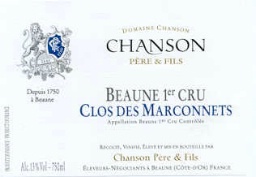
| Community Tasting Notes (average 93 pts. and median of 93 pts. in 2 notes) | | | Tasted by JiiTee on 8/18/2009 & rated 93 points: Beautiful bright colour. Very rich and impressing nose with flowers and honey. Excellent bouquet. Strong and powerful tannins with ripe berries, cherries etc. Long aftertaste. Very elegant and exquisite Pinot Noir. (154 views) | | | Tasted by Cosmo3 on 10/17/2008: Smooth finish. The nose is gentle and soft through and through. Is drinking well now. No dominating flavor; very well integrated. (291 views) |
| Producer website
· The House was founded in 1750 in the reign of Louis XV
· In 1999 Bollinger Champagne House infused 3.6 million dollars in 2002 in a 5-Year investment
program to improve the quality of Chanson's wines and vineyards. Among some of the changes:
lowering the yields and handpicking the grapes instead of using harvest machines.
· 2002 hired Jean-Pierre Confuron from Confuron-Cotetidot
· Landmark 15th-century bastion still used as a cellar maintains consistent tepmerature
· Chanson is one of the handful of domaines that remained intact following the redistribution of
ownership in the 18th and early 19th centuries (Jadot, Drouhin, Bouchard Père, and Louis
Latour are the other four members of this "most distinguished" club of shippers).
Winemaker
Jean-Pierre started his career working in his family Domaine in Vosne-Romanée and studied winemaking in Champagne and Burgundy at the University of Dijon. Jean-Pierre also lectures in viticulture and winemaking at the Lycée Viticole de Beaune. "Confuron purchased state-of-the-art plowing equipment, but adds that in some cases, "we began using horses to plow where tractors couldn't fit so that the vines in every corner of the vineyards could grow deep enough in the soil." He also eliminated machine harvesters and implemented handpicking."Jean-Pierre Confuron is also an active member of the "Union des Oenologues de France". He continues to act as consultant in various wine growing areas across the world. He was guest of Honour at the first Geelong Festival in Australia, joining James Halliday as member of Jury for the Len Evans Diploma.
Landmark 15th-century bastion
"The temperature of the bastion never varies," explains Chanson general manager Gilles de Courcel. "It is ideal for cold maceration of the bunches. In the springtime, we might open one of the cellar doors to allow the warm air in. We never accelerate malolactic fermentation. We allow it to occur spontaneously and naturally." Minimal intervention is the guiding philosophy today at Chanson. "We use only the best cuvées and we never hurry the process," says De Courcel. "This is how we maintain the freshness, purity, and fragrance of the wines."
About red wine
Varietal character (Appellation America) | Varietal article (Wikipedia)
Pinot Noir is the Noble red grape of Burgundy, capable of ripening in a cooler climate, which Cabernet Sauvignon and Merlot will not reliably do. It is unpredictable and difficult both to grow and to vinify, but results in some of the finest reds in the world. It is believed to have been selected from wild vines two thousand years ago. It is also used in the production of champagne. In fact, more Pinot Noir goes into Champagne than is used in all of the Cote d'Or! It is also grown in Alsace, Germany, the U.S., Canada, Australia, New Zealand, Croatia, Serbia, Italy, and so forth, with varying degrees of success.
Vins de France (Office National Interprofessionnel des Vins ) | Pages Vins, Directory of French Winegrowers | French Wine (Wikipedia)
Les vins de Bourgogne (Bureau interprofessionnel des vins de Bourgogne)
Burgundy - The province of eastern France, famous for its red wines produced from Pinot Noir and its whites produced from Chardonnay. (Small of amounts of Gamay and Aligoté are still grown, although these have to be labeled differently.) The most famous part of the region is known as the Cote d'Or (the Golden Slope). It is divided into the Cote de Beaune, south of the town of Beaune (famous principally for its whites), and the Cote de Nuits, North of Beaune (home of the most famous reds). In addition, the Cote Chalonnaise and the Maconnais are important wine growing regions, although historically a clear level (or more) below the Cote d'Or. Also included by some are the regions of Chablis and Auxerrois, farther north.
Burgundy Report
Grands Jours de Bourgogne 11. b?ezna 2008 - výborná reportáž Pavla Jelena.
Les Grands Jours de Bourgogne - na stejné téma od Heleny Baker. ANNATE
2007 annata di grande interesse anche per i rossi, leggibili ed espressivi come raramente avviene per i Borgogna così giovani.
Côte de Beaune (Bureau interprofessionnel des vins de Bourgogne)
|
|